
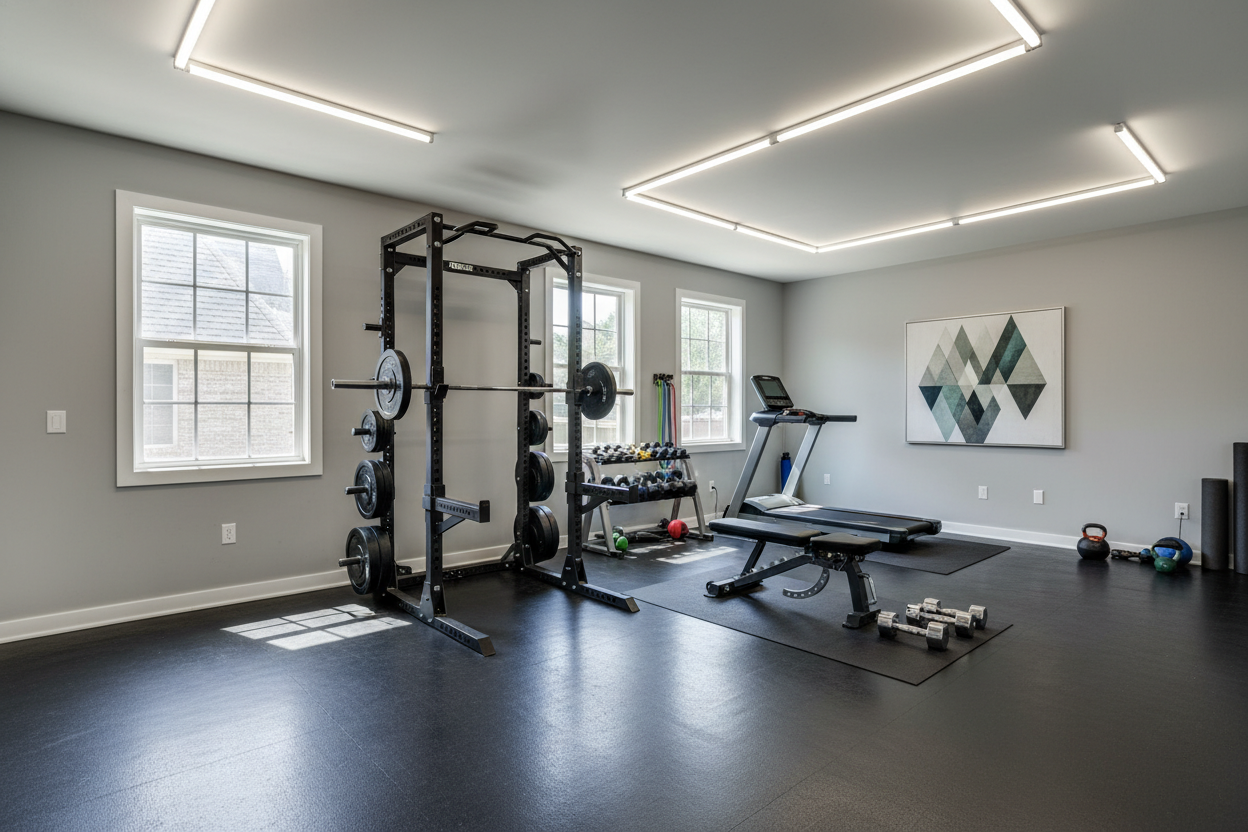
I remember the day the freight driver looked at my driveway and laughed. I’d just ordered a 'commercial-grade' selectorized lat pulldown because I was tired of my cheap plate-loaded unit sticking and rattling. I thought buying professional exercise equipment was the ultimate flex—the final step in turning my two-car garage into a sanctuary.
Then the pallet arrived. It was 800 pounds of steel and bolted to a wooden base that wouldn't fit through a standard pedestrian door. I spent four hours in the rain with a socket wrench just to get the thing inside. By the time it was assembled, I realized I’d made a massive mistake. It took up nearly 25% of my lifting floor, and the weight stack was so tall it cleared my garage door opener by exactly half an inch.
Quick Takeaways
- Commercial gear is built for 24/7 abuse from strangers, not your 45-minute morning session.
- Standard garage ceilings (usually 8 or 9 feet) are often too low for 'pro' racks and pulldowns.
- You are paying for 7-gauge steel and over-engineered bolts you will never actually stress-test.
- Prosumer gear—11-gauge steel with a smaller footprint—is the actual sweet spot for home lifters.
The Nightmare of Moving Commercial Gear Into a Garage
The first thing nobody tells you about professional gym equipment for home use is the sheer mass. Commercial machines are designed to stay put for a decade in a 10,000-square-foot facility. They use massive footprints to ensure stability when a 300-pound lineman is throwing weight around. In a garage, that 48-inch depth suddenly feels like a canyon.
I learned this the hard way when I tried to fit a full-sized competition rack. I couldn't even walk around the side of it without shimmying like a cat. That’s why I traded my full rack for a compact weight training home gym setup. Most residential slabs are only four inches thick; dropping a 500-pound commercial stack can actually crack your concrete if you aren't careful with your subflooring.
You're Paying for 'Idiot-Proof' Durability, Not Better Workouts
When you buy professional workout equipment, you aren't necessarily getting a 'better' pump. You’re paying for liability protection. Commercial manufacturers build things to be 'idiot-proof.' They use thicker steel and redundant safety catches because they know a teenager will eventually try to use the machine backward or drop the stack from the top pin.
As a solo lifter, you don't need 7-gauge steel. It’s overkill. I realized I wasted 3k finding the best weight equipment for home gym setups by chasing brand names that look good in a Gold's Gym but offer zero extra utility for my 5/3/1 program. You’re paying for a 1,000-rep-per-day lifespan when you only need a 10-rep-per-day lifespan.
Where the Pro-Grade Premium Actually Makes Sense
I’m not saying all pro gear is a waste. There are specific categories where the commercial bearings and pulley systems are worth every penny. If you buy a cheap residential cable machine, it will eventually feel 'crunchy' as the plastic pulleys wear down. This is especially true for complex machines with moving parts.
For example, a high-end Smith machine home gym station is one place where I’d spend the extra cash. The linear bearings in a pro version feel like butter, whereas the residential versions often catch or tilt if your hand placement isn't perfectly centered. If it has a cable or a pivot point, go pro. If it’s just a hunk of steel, stay residential.
Finding the High-End Consumer Sweet Spot
The real 'pro' move isn't buying a Life Fitness or Hammer Strength unit. It's buying 'prosumer' gear. This is professional weight training equipment scaled for a garage. Look for 3x3-inch uprights and 11-gauge steel. This gives you the stability of a commercial rack without the 96-inch height that hits your rafters.
A perfect example of this middle ground is a heavy-duty adjustable weight bench. You want the 1,000-lb capacity and the zero-gap design of a pro bench, but you don't need the 100-lb frame that requires wheels just to move it three inches. Focus on the specs—steel thickness and bearing quality—rather than the 'commercial' label on the box.
Is professional equipment too heavy for a second-story home gym?
Usually, yes. A commercial leg press can weigh 600 lbs before you even add plates. Most residential floor joists aren't designed for that kind of concentrated dead weight. Stick to 11-gauge steel racks and plate-loaded options if you aren't on a ground-floor concrete slab.
Does commercial gear hold its resale value better?
Surprisingly, no. It’s harder to sell a massive commercial machine because the buyer also needs a truck and four friends to move it. 'Prosumer' gear from reputable home-gym brands actually holds its value better because it’s easier to transport in a pickup truck.
How do I know if a machine will fit my ceiling?
Measure twice, then subtract four inches. You need room to actually assemble the top bolts and potentially reach over the top for cable maintenance. If your ceiling is 96 inches, do not buy a 92-inch rack unless you want to scrape your knuckles every time you do a pull-up.
Share:
Are the Latest Fitness Machines Actually Better Than 90s Iron?
I Went Back to the Big Life Gyms (Here is What I Realized)