
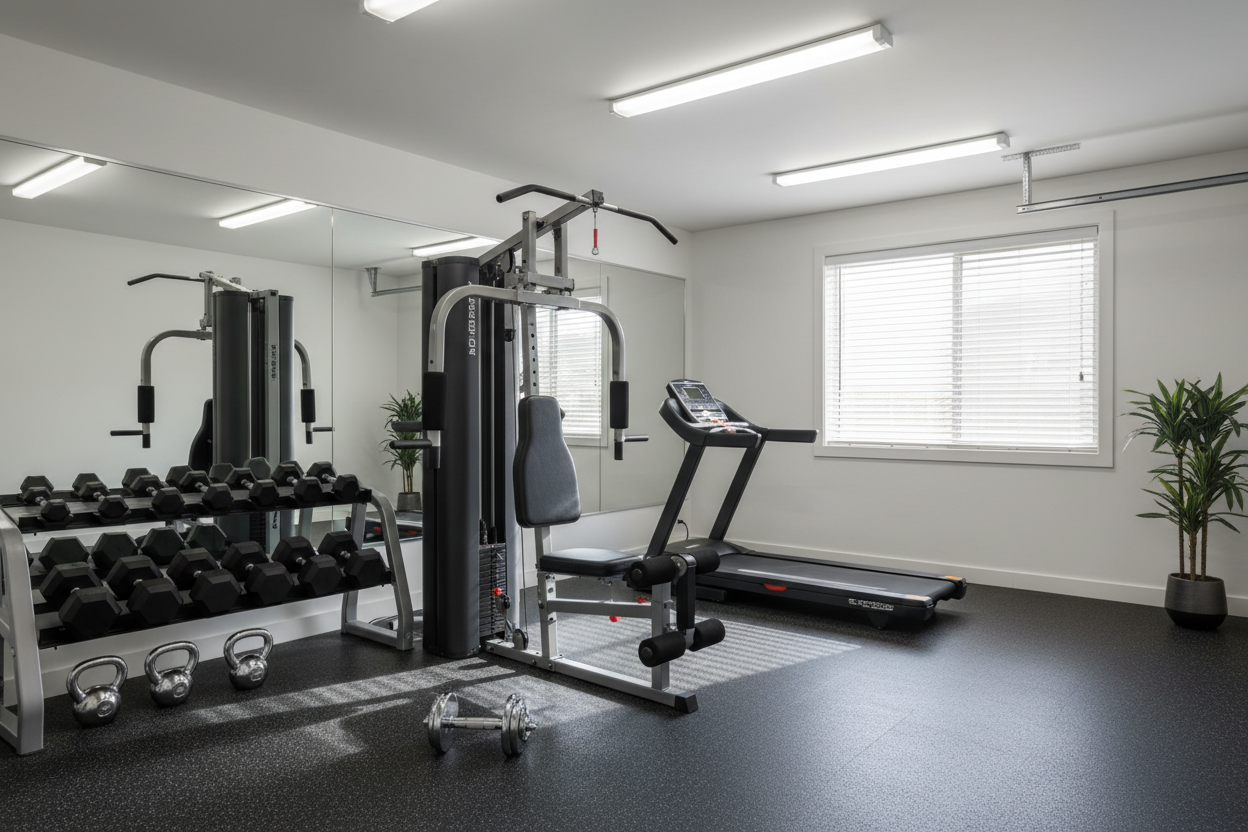
I remember the first time I walked into a commercial gym in the late 90s. The centerpiece wasn't a squat rack or a platform—it was a massive, chrome-plated beast that looked like it could launch a satellite. When you start universal gym weight machine shopping, you are usually chasing that same 'everything in one' convenience. You imagine a world where you never have to strip plates or hunt for a matching pair of dumbbells. But your garage isn't a 20,000-square-foot commercial facility, and what looks efficient in a showroom often becomes a giant, dusty clothes rack in a residential setting.
Quick Takeaways
- Universal weight machines require a 360-degree 'buffer zone,' making their actual footprint much larger than the specs suggest.
- Fixed pivot points often force your joints into awkward angles, unlike free weights or adjustable cable columns.
- Maintenance is a headache; if one cable snaps or a pulley shears, half the machine is usually out of commission.
- A quality rack and a dedicated cable tower almost always offer better bang for your buck.
The Nostalgia Trap of the Classic Multi-Station Rig
There is a specific psychological pull to the universal weight training machine. It promises a complete physique in a single purchase. When you are first building out a home gym, the sheer number of exercises listed on the marketing flyer—'Over 50 gym-quality movements!'—feels like an incredible value proposition. You see the chest press, the lat pulldown, and the leg extension all bolted together and think you’ve solved the equipment puzzle in one shot.
This nostalgia usually stems from old-school gym equipment universal setups we saw in high school weight rooms. They felt sturdy because they weighed 2,000 pounds and were bolted into concrete. The consumer versions, however, are a different animal. They try to replicate that experience with thinner gauge steel and plastic pulleys. Most people default to these because they fear the learning curve of a barbell, but they end up trading a slight learning curve for a lifetime of mediocre range of motion and clunky transitions.
Why I Usually Talk People Out of Buying One
I have spent a lot of time on universal weight equipment, and the 'convenience' factor is largely a myth. The biggest issue is the shared weight stack. On most universal weight machines, you have one or two stacks powering four or five different stations. This means the cable routing is a nightmare of friction. By the time the force travels through five pulleys to get to your hands, a 100-pound setting feels like 70 pounds on the way down and 120 pounds on the way up because of the drag.
Then there is the transition time. You finish your 'bench press' and want to move to rows, but you have to unpin a handle, move a bench, and adjust a leg stopper. In the time it takes to reconfigure a universal workout machine, I could have finished a set of dumbbell presses and moved to the pull-up bar. These machines are designed to look impressive in a brochure, but in a real training session, they often feel restrictive. You are locked into the manufacturer's idea of a 'perfect' chest press, which rarely accounts for people with longer arms or pre-existing shoulder issues.
The Footprint is an Absolute Nightmare
Don't look at the dimensions on the box; look at the 'working area.' A universal exercise machine might technically be 5x7 feet, but you can't put it in a 5x7 corner. Because the stations are usually spread around the perimeter, you need three feet of clearance on the left for the leg press, three feet on the right for the pec dec, and space in the front for the rows. You end up needing a 12x12 foot space just to use the thing safely.
In a standard two-car garage, a universal gym for home use effectively kills your ability to park a car or store anything else. It becomes the island in the middle of your room that you have to constantly shimmy around. If you put it against a wall to save space, you immediately lose access to half the exercises you paid for. It is the least space-efficient way to train, despite what the 'all-in-one' branding tells you.
The 'Jack of All Trades' Biomechanics Issue
Biomechanics are where these rigs really fail. Because the machine has to accommodate everyone from a 5-foot-tall beginner to a 6-foot-4 athlete, the pivot points are compromised. I have used a universal fitness machine where the chest press arch was so shallow it felt like I was doing a weird tricep extension. You are much better off with a dedicated chest press machine with independent arms that allows for a natural converging motion.
When arms move independently, your stronger side can't compensate for your weaker side. On a classic universal gym set, the handles are usually connected to a single bar. If your right pec is stronger, it does 70% of the work, and you never fix the imbalance. Modern specialized equipment has moved away from this 'fixed bar' design for a reason—it’s simply not how the body naturally moves under load.
Smarter Alternatives for Your Garage
I’ve made the mistake of buying the 'budget' version of these rigs. A few years back, I tested 4 cheap home weight machines and kept exactly zero of them. The frames flexed under heavy loads, the powder coating flaked off within a month, and the cables felt like they were rubbing against sandpaper. If you aren't spending $4,000+ on a commercial-grade multi-stack, you are likely buying a headache.
Instead of a universal gym sets approach, I always recommend a modular setup. Buy a solid power rack first. Add a high-quality adjustable bench. This combination allows for hundreds of movements with a footprint that actually stays against a wall. You can add plate-loaded attachments as you go, rather than dropping $2k upfront on a machine that has five exercises you'll never actually use.
The Rack and Cable Combo
If you crave the feel of a universal weight system but want better results, look at a functional trainer or a power rack with an integrated cable system. A smith machine home gym station is a much more versatile all-in-one alternative. It provides the safety of a fixed path for heavy presses but usually includes dual adjustable pulleys. This gives you the 'machine' feel for isolation work while keeping the footprint manageable.
With a cable-based system, you aren't stuck in one seat. You can do standing cable crossovers, low rows, face pulls, and woodchops. The versatility of a dual-adjustable pulley far outweighs a fixed universal exercise equipment station where the seat is bolted to the floor and the handles only move in one direction.
The Final Verdict: Pass or Purchase?
So, should you buy a universal workout equipment setup? If you have a 1,000-square-foot basement and you just want to get 20 minutes of 'circuit training' in without thinking, maybe. It’s better than sitting on the couch. But for anyone serious about making progress, the limitations are too high. You will outgrow the weight stack, get frustrated with the fixed range of motion, and eventually wish you had that floor space back.
Most lifters are better served by focusing on the weight equipment you actually need: a rack, a bar, some plates, and maybe a single, high-quality cable tower. You'll get better muscle activation, more variety, and you won't have to move a literal mountain of steel when you decide to rearrange your garage.
Universal Gym FAQ
Are universal gym machines good for building muscle?
Yes, you can build muscle on them, but you may hit a plateau sooner than with free weights. The fixed path of motion limits the recruitment of stabilizer muscles, and most home units have weight stacks that top out at 150-200 lbs, which isn't enough for long-term leg training.
How much ceiling height do I need for a universal machine?
Most stand about 82 to 84 inches tall, but you need at least 90 inches of clearance. You have to account for the top pulley height and the fact that you might need to reach over the top of the machine for maintenance or cable threading.
Can I move a universal gym by myself?
Absolutely not. These units usually arrive in 5 to 7 heavy boxes. Once assembled, they are nearly impossible to move without a full teardown. If you're a renter or plan on moving soon, avoid these machines like the plague.
Share:
Are Dedicated Upper Body Workout Machines for Home Worth the Space?
The Brutal Truth About Bowflex Home Gym Models for Lifting