
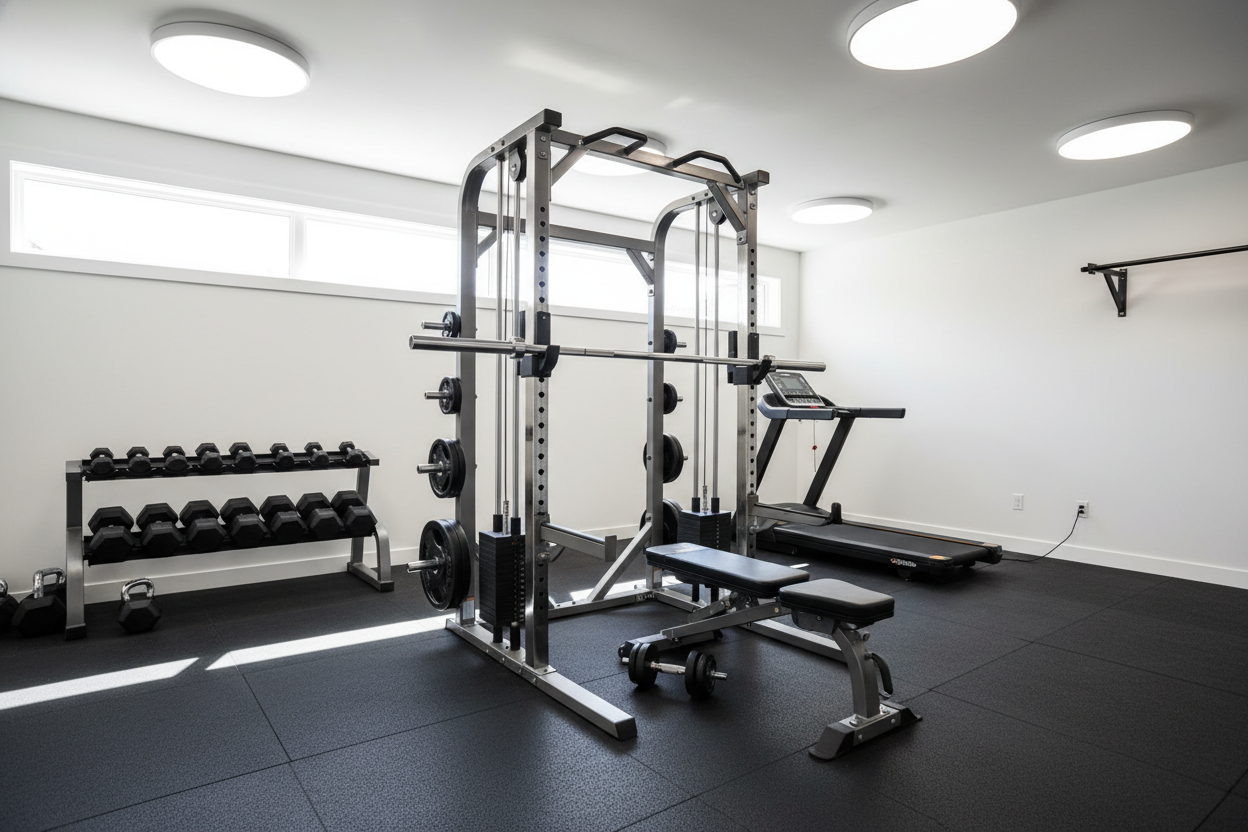
I spent years training in a garage gym equipped with a budget power rack that shook every time I racked a bar over 225. I told myself it didn't matter—steel is steel, right? Then I walked into a high-end facility in Montreal and spent twenty minutes on an atlantis smith machine. It ruined me. The difference between a consumer-grade track and a commercial masterpiece isn't just aesthetic; it is the difference between fighting the equipment and actually training your muscles.
- Starting Bar Weight: 20 lbs (9 kg) thanks to the internal counterbalance.
- Guide Rods: Case-hardened steel for zero-flex stability.
- Bearings: Industrial-grade linear bearings that eliminate 'stick-slip' friction.
- Safety: Adjustable bottom stops that actually hold up under heavy drops.
The Day Budget Gear Ruined My Workout
We’ve all been there. You’re at a local community center or using that 'all-in-one' home gym system, and you try to do a slow-tempo overhead press. Halfway up, the bar hitches. It’s not your strength failing; it’s the cheap plastic bushings on the guide rods catching. It’s frustrating, and frankly, it makes you want to skip Smith work altogether. That jittery movement is the hallmark of gear designed for a price point rather than a performance standard.
When I first touched the Atlantis version, I realized I had been compensating for bad engineering for years. There was no lateral sway. No metallic scraping sound. It felt like the bar was floating on a magnetic rail. If you are serious about hypertrophy, that lack of friction means you can actually feel the target muscle stretching and contracting instead of managing the 'jerkiness' of a budget sled.
What Actually Makes This Thing So Smooth?
The secret isn't magic; it’s tolerances. Atlantis uses oversized linear bearings that are significantly beefier than what you’ll find on a standard rack. Most home units use thin guide rods that can bow under a heavy load, creating a 'pinching' effect that slows the bar down. Atlantis uses thick, case-hardened rods that stay perfectly vertical even if you’ve got four plates per side. Is The Valor Fitness Smith Machine Actually Smooth Under Heavy Weight? It’s a solid mid-tier option, but it still relies on a simpler carriage system that can’t compete with the industrial precision of a Canadian-engineered Atlantis rig.
The frame itself is a tank. We’re talking 11-gauge steel and a footprint that refuses to budge. I’ve seen guys try to 'manhandle' these machines during heavy shrugs, and the frame doesn't even vibrate. That stability is what allows the bearings to do their job. When the frame is rigid, the guide rods stay perfectly parallel, which is the only way to get that 'glass-like' travel during a rep.
Solving the Atlantis Smith Machine Bar Weight Mystery
The biggest headache for any data-driven lifter is figuring out the atlantis smith machine bar weight. If you walk up and lift the bar, it feels light—dangerously light. That’s because Atlantis uses a sophisticated internal counterbalance system. While a standard Olympic bar is 45 lbs, the effective starting resistance on this machine is exactly 20 lbs. This is a deliberate choice to allow for rehab movements and high-volume shoulder work where a heavy starting weight might be a barrier.
I remember when I Finally Figured Out the Freemotion Smith Machine Bar Weight and realized I had been under-reporting my lifts for months. Atlantis is more consistent across their product line, but you still have to account for that 25-lb 'discount' provided by the counterweights. If you’re moving from a standard squat rack to the Smith, don’t just match the plate weight—math it out so your progressive overload stays honest.
Why Counterbalances Mess With Your Lifting Math
Inside those vertical columns, there are actual weights attached to cables that pull upward on the bar carriage. This offsets the weight of the steel bar and the bearing housings. While this makes the movement feel incredible, it changes the physics of the lift. Because you aren't fighting gravity on the full mass of the bar, the 'inertia' feels different at the start of the rep. It’s great for your joints, but it can be a bit of an ego check when you go back to a 'dead' bar that has no help from a pulley system.
Is It Actually Worth the Footprint in a Home Gym?
Let’s be real: this thing is a monster. It’s roughly 86 inches tall and needs a significant amount of floor space. If you are building a 'dream' home gym and have the budget, it’s the last Smith Machine you will ever buy. However, for most people, the shipping alone—which usually involves a full-size pallet and a liftgate—is enough to make them reconsider. It isn't a 'flat-pack' piece of furniture; it’s a piece of heavy machinery.
My personal mistake? I once tried to move an older Atlantis unit into a basement with a low ceiling. I didn't account for the height of the guide rods during assembly. I ended up having to notch out the drywall in the ceiling just to get the rods to seat. Measure twice, or you’ll be doing unplanned home renovations. If you have the space and the cash, the lack of maintenance alone makes it worth it. You won't be greasing these rods every month like you do with cheaper chrome-plated versions.
How to Pair Your Premium Rig
If you’re going to invest in a track system this good, don't ruin the experience with a cheap, narrow bench. You need a base that is as wide and stable as the machine itself. I recommend something like the Weight Bench Chest Press Machine Independent Arms Z1 Pro. Having a bench that locks into position and doesn't slide on the floor is crucial when you are trying to align your chest perfectly with the bar path of the Smith machine.
FAQ
What is the exact bar weight of an Atlantis Smith Machine?
The starting resistance is 20 lbs (9 kg). The counterbalance system offsets the actual weight of the bar to make it more versatile for all strength levels.
Does it require special maintenance?
Not much. Unlike cheap machines that need constant silicone spray, these linear bearings are mostly self-contained. Just keep the guide rods wiped clean of dust and sweat.
Can I use standard Olympic plates?
Yes, the sleeves are designed for standard 2-inch Olympic plates. The weight horns are usually long enough to fit at least five or six 45-lb plates per side, depending on the plate thickness.
Share:
Are Functional Trainer Home Gyms Really Worth the Garage Space?
Why Pull-Ups Aren't Enough: The Back Exercise Home Equipment You Need